 Last updated: November 2026 · This post contains affiliate links, which may earn me a small commission at no extra cost to you.
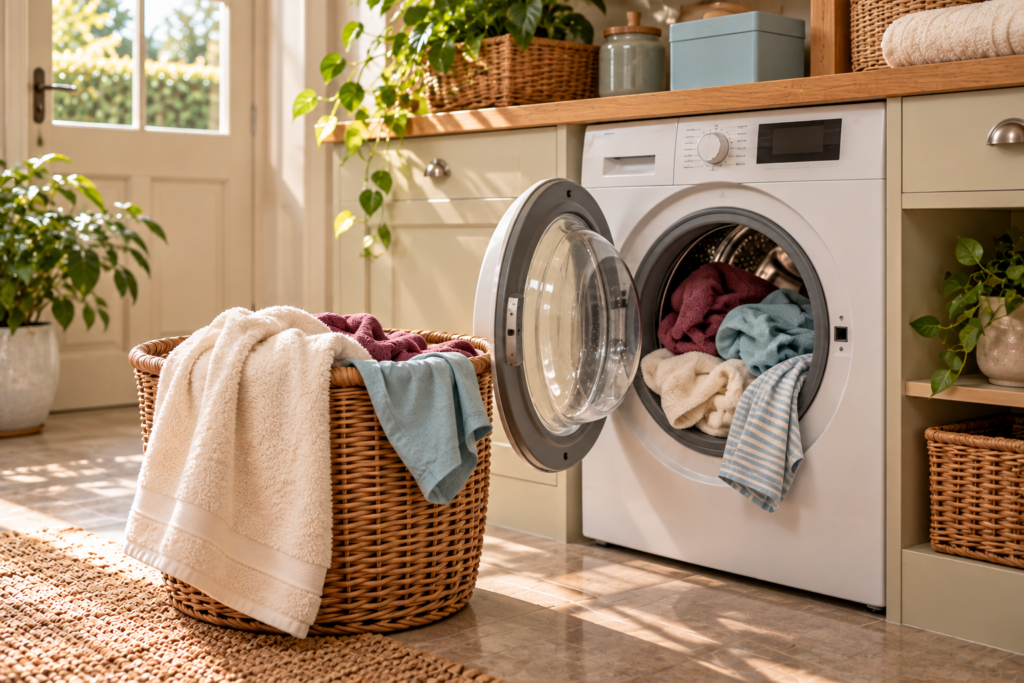
The washing machine has finished, the basket is full again, and it’s raining outside. A classic day in Ireland! How do you get the family’s laundry back into the wardrobes without drying taking an eternity or sending your electricity bill through the roof?
Here is my daily routine, practical tips for smaller households, and a few clever helpers that make drying and ironing so much easier.
1. Pick the Program for What You’re Actually Washing
I wash almost everything using the standard Mix Fabrics cycle, which normally takes 2 hours. However, my machine has a handy ‘Fast’ button that cuts the cycle down to exactly 1 hour at 30–40 °C.
This 1-hour quick wash is more than enough for everyday clothes, school uniforms, and even my husband’s work overalls. School uniforms occasionally suffer a “yogurt explosion” (how my son manages that at school remains a mystery!), but pressing the ‘Fast’ button gets everything perfectly clean without any pre-treating or stain removal needed.
Where I Really Save: Laundry Powder & Packaging
I absolutely swear by the budget-friendly Tesco Non Bio detergent powder in the light blue box. It’s super affordable and surprisingly effective.
An added bonus for me is that it comes packaged in cardboard — leaving zero plastic waste behind once it’s used up. It’s just a shame the same can’t be said for fabric softener, where a plastic bottle always ends up in the bin. At least I take comfort in knowing it gets recycled into a new bottle down the line!
2. Remove as Much Water as Possible in the Washer
The less water left in your clothes after washing, the faster they’ll dry on the rack. For sturdier fabrics, I always bump up the spin speed.
My Dry Towel Trick
When the cycle finishes, I throw one large, dry cotton bath towel into the drum with the wet laundry and run an extra spin cycle.
The dry towel absorbs a huge amount of excess moisture, and the clothes come out noticeably drier. Just keep in mind not to overload the drum, and make sure you hang the towel up to dry properly afterwards too!
3. Shake It Out and Smooth It Down
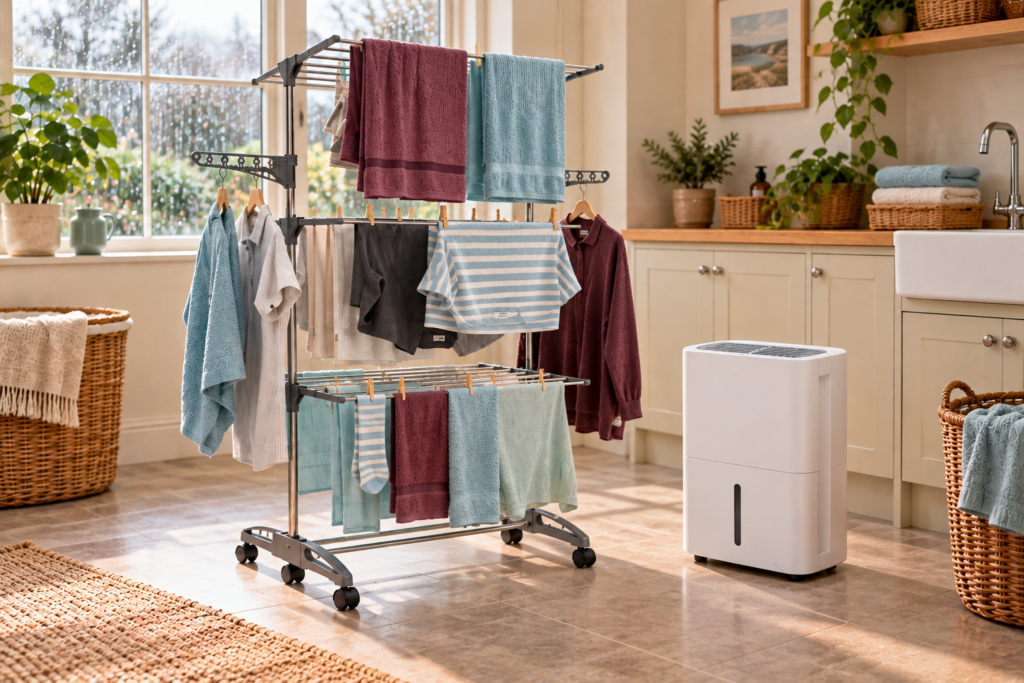
When hanging clothes, taking a few extra seconds per item makes all the difference. Give each piece a firm shake and smooth out the sleeves and trouser legs before hanging.
This prevents that awful “chewed up” look (though after a long day, I totally get just throwing it over the rack!).
-
- Give it space: Don’t cram a full wash load onto a tiny drying rack. Leave gaps between items so air can circulate.
-
- Shirts on hangers: Hanging shirts directly on clothes hangers and smoothing down the collars, cuffs, and button plackets will save you half the effort when ironing.
4. Find a Bright Spot with Good Airflow
Position your drying rack near a window where there’s plenty of natural light and good ventilation. If you’re in a small apartment and only have a corner or hallway to work with, just make sure there’s still enough space around the rack for air to move.
Remember, drying clothes indoors releases moisture into the room. Heat alone isn’t enough — that humidity needs an escape route, whether through a cracked window or a dehumidifier.
➜ Bosch Dry 1000 Dehumidifier (10L/Day) — View on Amazon

5. Tight on Space? Try a Wall-Mounted Folding Drying Rack
If a bulky freestanding clothes airer is constantly getting in your way, a wall-mounted folding rack is a game-changer. Simply pull it out when you have laundry to dry, and fold it flat against the wall when you’re done.
-
- What to check before buying: Double-check the weight capacity and the type of wall you’ll be mounting it on.
-
- Safety tip for families: Mount it high enough so it stays out of reach of young children.
➜ Wall-Mounted Folding Clothes Drying Rack — View on Amazon
6. Heated Clothes Airer: A Few Hours of Help
A heated clothes airer with a fabric cover is a lifesaver during rainy Irish days. And you don’t even need to leave it running all day!
My favorite routine is to run it for 4 hours and then turn it off. The laundry finishes drying naturally, often overnight. Just remember to unzip or open the cover after turning it off so moisture can escape. In the morning, just check the thicker seams or waistbands.
➜ Lazy-Dry 3-Tier Heated Clothes Airer with Cover (300W) — View on Amazon
7. Struggling with Damp? A Dehumidifier Works Wonders
If your windows fog up when drying clothes indoors and laundry takes forever to dry, a dehumidifier is an investment you won’t regret. It pulls moisture directly out of the air into a water tank.
You don’t need to buy a heated airer and a dehumidifier at the same time — a dehumidifier works amazingly well alongside a regular, unheated drying rack.
What to look for when buying:
-
- Power consumption and energy efficiency
-
- Noise level (especially if you plan to run it overnight)
-
- Water tank capacity
-
- A dedicated Laundry Mode
➜ Bosch Dry 1000 Dehumidifier (10L/Day) — View on Amazon
8. How Much Does Electric Drying Cost? (Cost Breakdown)
Here is a handy comparison showing how much a single drying session costs using different appliances and methods. (Calculated at an electricity rate of €0.35 / kWh).
| Drying Method / Appliance | Operation / Cycle | Consumption | Cost per Drying |
| Standard Drying Rack | No electricity | 0 kWh | €0.00 |
| Heated Airer (300 W) | 4 hours + air drying | 1.2 kWh | €0.42 |
| Dehumidifier (250 W) + Standard Rack | 4 hours + air drying | 1.0 kWh | €0.35 |
| Heated Airer + Dehumidifier | 4 hours + air drying | 2.2 kWh | €0.77 |
| New Heat Pump Tumble Dryer | 1 full drying cycle | approx. 1.38 kWh | €0.48 |
| Older / Standard Dryer (e.g., 7-year-old AAA) | 1 full drying cycle | approx. 3.5–4 kWh | €1.23 – €1.40 |
The Takeaway
As you can see in the table, modern heat pump dryers use so little electricity that running a full drying cycle costs roughly the same as running a heated airer for 4 hours. Older standard dryers, on the other hand, cost nearly three times as much to run!

9. Drying Rack vs. Tumble Dryer
I use a combination of both! Clothes dried outside on a clothesline have that wonderful, fresh outdoor scent, but Irish weather doesn’t always play ball.
| Method | Pros | Cons |
| Outdoor Clothesline | Zero electricity cost, fresh scent | Weather dependent, towels can feel stiff |
| Indoor Airer | Low running costs, gentle on fabrics | Takes up room space, increases indoor humidity |
| Tumble Dryer | Super soft clothes, fast, removes pet hair | Higher upfront cost, not all clothes are dryer-safe |
A Lifesaver for Pet Hair and Forgotten Tissues
If you have cats or dogs at home, you will fall in love with a tumble dryer. As it dries, it pulls the vast majority of pet hair right off your clothes, leaving it caught in the lint filter.
And here’s a quick personal experience: a dryer is also an absolute savior if you accidentally wash a paper tissue in a pocket! Those tiny white shreds loosen up in the dryer and end up trapped in the filter instead of you having to pick them off by hand.
10. Make Use of Solar Panels or Off-Peak Tariffs
Since we have 12 solar panels on our roof, I try to time my washing and drying for when they are generating peak power. If you have a solar app, keep an eye on your energy surplus and run your washer then.
If you don’t have solar panels, but your energy supplier offers an off-peak or Night Boost tariff, set your washing machine’s delay timer to run during those cheaper hours.

11. Less Ironing, More Time for Yourself
Ironing shirts can be a massive time-sink. Here is the simple routine that works for me:
-
- Don’t overload the washer — the less cramped the clothes are, the fewer creases they’ll have.
-
- Take shirts out immediately after the cycle ends.
-
- Shake them out thoroughly and hang them on hangers straight away.
-
- Use your hands to press and smooth down the collar, cuffs, and button strip.
-
- If you do need to iron them, do it while they are still slightly damp — the iron will glide right over creases!
Buy Shirts That Save You Time
Selecting the right fabrics when shopping makes life so much easier. When buying new shirts, it’s well worth looking out for Easy Iron or Non-Iron tags. These fabrics naturally smooth themselves out when hung on a hanger, so they either need no ironing at all or just a very quick steam.
➜ Easy-Iron & Non-Iron Shirts — View on Amazon
Have You Tried a Shirt Drying & Ironing Dummy?
This is a clever little appliance where you fit a damp, freshly washed shirt onto an inflatable torso form. The unit inflates with hot air, drying and pressing the shirt at the exact same time. It’s fantastic for households where shirts are worn daily, even if a quick touch-up on the collar is occasionally needed with a traditional iron.
➜ Ironele Automatic Ironing Machine — View on Amazon
Top Amazon Laundry Helpers (Quick Summary)
If you’re wondering which drying companion would suit your home best, here is a quick overview with direct links:
| Helper / Product | Best Used For | Link on Amazon |
| Vertical 3-Tier Clothes Airer | Saves floor space, holds a huge load vertically. |  View on Amazon |
| Wall-Mounted Folding Airer | Perfect for small rooms and hallways — folds completely flat against the wall. | View on Amazon |
| Heated Airer with Cover | Speeds up indoor drying on rainy days with low power draw. | View on Amazon |
| Dehumidifier (with Laundry Mode) | Fights dampness, stops window condensation, and speeds up ambient drying. | View on Amazon |
| Energy-Efficient Heat Pump Dryer | Maximum convenience, fluffy towels, and effortless pet hair removal. | View on Amazon |
| Shirt Drying & Ironing Dummy | Automatic drying and crease-smoothing for shirts without manual effort. | View on Amazon |
Final Thoughts
You don’t need to go out and buy every single gadget at once. Start by making small tweaks to your routine: choose a quicker cycle, don’t overload the machine, crank up the spin speed, and give your clothes a good shake before hanging. From there, you’ll easily see whether you need a new heat pump dryer, a dehumidifier, or simply a space-saving wall rack!